
Becky Kospanova
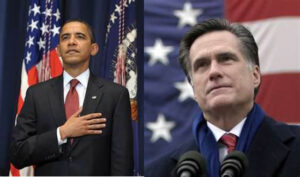 In several days, on November 6, 2012, American people will choose their 45th President and the Electoral College election will take place on December 17, 2012. The race between Democratic current President Barack Obama and Republican nominee Mitt Romney is rather close – different polls alternatively show one or another candidate leading by just few points, and it is clear that the outcome of election greatly depends on such factors as voters’ turnout, undecided voters, and swing states. Moreover, the recent tragedy of superstorm Sandy might also influence the results of the election by affecting early voting results, preventing people from voting altogether, or making them change their choice based on perceived ability of President Obama to handle the crisis of such enormous magnitude.
Still, majority of voters base their decision on most important to them issues and the candidates’ stand on them. What are the issues that interest the American public the most? Generally, most political polls and observers report that Americans are very concerned with economy and especially unemployment rate, budget deficit, education, foreign policy, terrorism control, immigration, health care, abortion and birth control, as well as the host of other issues. As such, the voters need to familiarize themselves with at least two major points of each candidate’s platform in order to make an informed decision.
Economic policy is one of the most important topics. As everybody knows, American economy plunged into recession during previous Bush’s administration and in 2008, Obama made a promise to do everything in his power to restore it. Undoubtedly, a lot has been done – Obama implemented $ 800 billion stimulus plan to save financial and auto industries and unemployment rate is steadily, though slowly, falling (to compare, in September 2009 the rate was 9.8% and in September 2012 it was 7.8%). As such, he supports domestic companies by promising to provide tax cuts to companies which keep their operations in the USA and tax penalties to these companies which outsource. He wants to cut the debt by reducing government spending and increasing revenues by repealing tax cuts to the families which make more than $ 250.000 annually and raising taxes for the wealthy. Romney, on the other hand, supports decreased government regulation, balanced budget, and lower taxes for all strata of population, especially the rich. He proposes the replacement of jobless benefits with unemployment savings plan and wants to decrease government spending by cutting down the financing of some social programs, most notably Planned Parenthood. He supported the bail-out of financial institutions while opposing the help to auto industry, and is in favor of relaxing the laws which regulate the operations of financial and corporate companies.
Another important issue is health care. Obama’s big achievement was the passing of the Affordable Care Act by the Congress in 2010 which, in case of his winning, will be implemented by 2014. In short, it is a universal coverage health plan which will provide coverage to all Americans no matter the pre-existing conditions, people will receive tax credits to pay the premiums, private employers will receive tax incentives to provide affordable insurances to their employees, and insurers will have to compete for their businesses by supplying high-quality plans. Romney, first of all, calls for the repeal of Obamacare and proposes the establishment of individual tax-advantaged medical savings accounts to pay for premiums and medical costs. He believes that states, not federal government, should regulate the policy for uninsured people and trusts the private sector to successfully compete in the area of medical insurance. Moreover, they differ dramatically in regard to abortion rights and contraception. Obama believes in women’s right to choose and the availability of fully paid contraceptives for women with work-based insurance. Romney supports anti-abortion policy and hopes that the future Supreme Court will overturn Roe vs. Wade.
Of course, the choice of the candidate is determined by a person’s belief system and his vision of the future of the country. Thus, on November 6, 2012 the voice of American people will be, hopefully, heard.

 On November 6, 2012, American people will vote to determine who is going to be the President and the Vice-President of the USA for the next four years. The main choice is between present Democratic President Barak Obama and his Vice-President Joe Biden and Republican Mitt Romney, former governor of Massachusetts, and his Vice-President nominee Paul Ryan. However, there are two other candidates who have achieved ballot access sufficient enough to win the election by the majority of the Electoral College: the Libertarian nominee and former New Mexico Governor Gary Johnson and the Green Party nominee Jill Stein. Still, many people do not fully comprehend what Electoral College is and how it influences the outcome of Presidential elections.
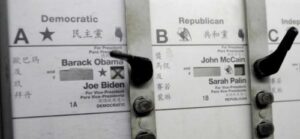 There are many critics of the Electoral College system. Many people argue that the true voice of American people gets lost during the Presidential elections and the outdated Electoral College system does no longer reflect the real choice of general population. This critique is not without some basis. Everybody remembers the Presidential elections of 2000 when Al Gore lost the election race to George W. Bush despite gaining the majority of popular votes but losing the Electoral College votes. Bush had won 271 electoral votes while only getting 50,456,002 popular votes and Gore had won 50,999,897 popular votes but only 266 electoral votes. However, it was mostly an exception rather then the rule. So far, the same situation has happened only two more times in history when Republican candidate Rutherford B. Hayes won the elections against Democrat Samuel Tilden in 1876; and Republican Benjamin Harrison won the elections against Democrat Grover Cleveland in 1888 on the basis of electoral votes.
 Before unraveling the path-breaking algorithm that effectively produces smart ideas, let’s make an attempt to alter your perspective towards genius people. When you think of great legends like Albert Einstein, Thomas Edison, Isaac Newton, Steve Jobs or other innovators, what is the general notion defining their high intelligence quotient? Yes, of course you relate it to some super-powers, which they might possess. This is not because you resolutely believe in myths but because it’s a human tendency to presume extraordinary things as myths rather than accept the blunt reality that such things can be possible without anything supernatural. It just seems easier to judge this way, isn’t it? Apart from this confusion between myth and realism, there also lies a perception that geniuses exhibit unusual behavior and eccentric habits, which make them, stand out of the rest. No, none of it is true.
 cause of some special genes but of the unfamiliar mind strategies used by them. These tricks don’t obey the rules of the general norm, but anyone who is aware of it can gradually master it. So, this is the perspective you need to hold on to till you discover the steps that lead to an estimated mastermind outcome. Now it is far more empowering and motivating to believe that such innovations are rational and not mythological. It is indeed thrilling that some nifty skills can push the boundaries of inventiveness. Take this as an inspiration that each one of us can be revealed to a better thinker suppressed inside us just by intentionally positioning our mind on the lines of ingenuity.
 It has been observed over the years by researchers that innovation is not the end result of a genius attribute instilled in a person. The reason why some people generate such rich ideas is because they make intentional efforts and as anticipated it leads to a splendid invention. The method is simple, it just requires you to be focused and exercise your brain as directed. Try the following steps:
 Aboriginal women at this time also lost their artistic practices, which was a deeply religious and spiritual practice. Their artwork symbolized their culture, their lives and told of dream-time stories that were passed onto their children. Art was a form of worship, central to their beliefs, and this too was stripped from them.
 Aboriginal women had a significant role before the colonization of Australia as all indigenous female lived their daily lives independent from men. In addition, they were economically independent and had status and value within the community. For example, they produced 80% of the diet and played a key role in the socialization and education of the children. They passed on information about indigenous tribal law and vital kinship structures that influenced social behavior.
 the same card. However, in a modern world, the looks can matter a lot. It was statistically proven that better-looking and taller people earned more compared to their less fortunate in the looks department and shorter colleagues, no matter the qualifications. It is just simple human psychology – people like good-looking and tall people, they appraise them more favorably, and they tend to grant them more favors than to worse looking people.
 The question stands now if it really matters how you look and how tall you are. In my honest opinion, it does matter how you look because it projects a certain image about you to an outside world. If you are fit, well cared, healthy, and well groomed – it shows determination and, basically, respect for what you’ve been given.
 One of the basic characteristics of people in any country and at any age is the tendency to develop stereotypes about particular groups or classes of people. Webster dictionary defines stereotypes as “conforming to a fixed or general pattern; especially: a standardized mental picture that is held in common by members of a group and that represents an oversimplified opinion, prejudiced attitude, or uncritical judgment.” While some stereotypes can be positive (such as “all babies are cute,” “all Hispanics are family oriented,” “Asians are good at math,” , etc.), majority of them are not and can lead to unnecessary misunderstanding and unfounded judgment.

 Right from birth, each one of us has evolved into a set pattern of human traits; the major constituents being the variation in mind-set, opinion and behavior. These three elements blend together to lay the foundation of the personality type we possess and showcase in our daily lives. Just by observing the known and unknown people around us, it can be inferred that each person is born with a unique vibe. If their actions are in-tune with ours, there is a strong bond of compatibility formed. But in cases of disparity like the two extremes (introverts and extroverts) stumbling upon each other, major survival issues and acts of repulsion are observed. This happens because of their intolerance towards each other’s contrasting traits.
 For Introverts: Being in a state of solitude suits you the best but don’t let this seclusion keep you trapped without having any connection from the external world. Experiencing the social world once in a while is not that terrible after all. Try to spare some time to socialize with people and let them recognize that concealed fun side of you.



 chatting with friends and suddenly you realize that you heard this conversation before. You know exactly where the discussion is leading too and what will be said. Or you visit a place for the first time and that feeling comes over you that you have been there before. It’s not surprising if you are also one of the 70% of the people who claim to have gone through what some would considered a bizarre experience. The reasons and why this happens is a mystery that still continues to go through numerous theories and studies by and between several groups of people. Psychoanalysts explain this as a method of fantasy fulfillment while Psychiatrists describe it as a short circuit occurring in the brain when an event makes its way into the memory, just a split second before you become mentally aware of the event.

 also a great opportunity. Our days are typically crammed with tasks and technology. How often do you get a few minutes to yourself (not counting watching TV, being on the computer or listening to your iPod)? Just a few minutes to actually sit in silence and gather your thoughts can help. If that doesn’t sound appealing, use the time to call and catch up with a loved one or to listen to calming music or a new audio book. The key is to accept that at this very moment, there’s nothing you can do about all the congestion. Many of us sprint through our days. Traffic – though upsetting — gives us the opportunity to slow down and do something more pleasant than stew in our seats.
 Another tip: As you feel the rage for a slow employee rise, try to muster up some empathy. No doubt at some point in your life you were slow at a new job (or in another situation). Rather than getting angry put you in their shoes. Anger ignites impatience. But empathy can ease irritation, and help patience prosper.
 Seek patience
 The development of technology for the last few decades is truly impressive. In particular, cell phones, which were first introduced in the 1980s and has made a spectacular jump from simple devices intended for just talking to multi-purpose gadgets. Nowadays, smart phones can be used by their owners as computers to surf the web, video and photo cameras, music players, calendars, gaming systems, GPS navigators, and much more. Of course, all these additions while very convenient may come with a price.
 provide.
 He ordered his eldest son, his nephew, and his second wife put to death. He tortured, murdered and imprisoned anyone, including cousins and former friends, known or suspected of being political rivals. He issued an edict on religious freedom for all in his dominions yet dismantled temples and looted their treasuries. He proclaimed himself a follower of the Prince of Peace, yet his path to undisputed power was littered with battles, great and small.
 authorities had launched a systematic assault to suppress Christianity. It was a time referred to by members of that community as the “Great Persecution.”
 Summer and Beach- What to Wear and How to Protect Yourself from the Sun!
 and oversized sunglasses are in. Also, the color of your sunglasses can vary widely from pink, yellow, and blue to classic grey, black, and brown. Gradient lenses are also popular in 2012. Also, to better protect yourself from relentless sun, bring a brimmed hat or at least a cap. Floppy wide-brimmed hats seem to be all the rage this season. For leisurely strolls along the beach, bring along a cover-up such as chiffon skirt, sarong, or wrap; and for a man, light t-shirt always works well. You can also improve your beach look by playing with your footwear. Instead of plain and boring flip-flops, choose sandals decorated with beads, rhinestones, or appliqués for a true fashion statement.
 Perhaps Leonardo Da Vinci said it best, “Once you have flown, you will walk the earth with your eyes turned skyward, for there you have been, and there you long to return.” Certainly that lyrical sentiment was true for the two men who celebrate a record setting, 25th anniversary this July.
 Due to weather conditions, the landing site had been altered from the British Isles to the Ireland coast. Technically, they touched down briefly on the targeted beach but a mechanism that releases the balloon from the capsule failed to work. Soon, they were on a bumpy, bouncing ride across the channel. Rough, contentious seas seeped into the capsule. Though there was some discussion on coaxing the limping conveyance to shore, both men concluded it was wiser to hazard a helicopter rescue from the water after a 60-foot leap off the capsule roof. Despite their soggy touchdown, the trip was an undeniable success.
 The 4th of July is probably one of the most well-known and beloved holidays in the United States of America. Everybody looks forward to firing up some barbecue, inviting friends and family to share their meal, watch the fireworks, and enjoy all things American. However, there is considerably more behind this holiday than the usual things, which came to be associated with it. While most people connect the 4th of July with such words as Concord, Lexington, Bunker Hill, and the “British Are Coming,”- there is more to the history of the Independence War. Most people associate the white Protestants as a major force behind the Independence War. However, it was not exactly the case. There were other segments of American population, which provided invaluable input toward the ultimate goal of achieving independence from the British Empire.